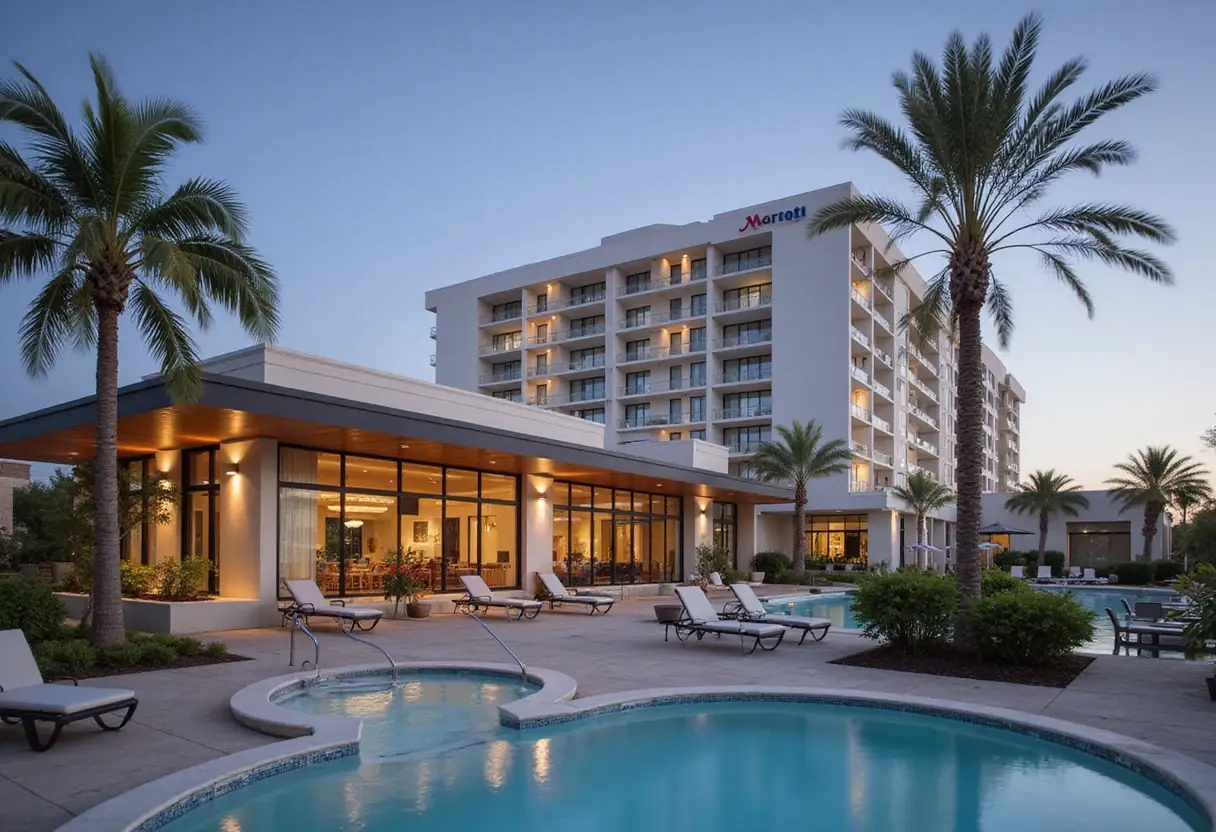
Marriott, Hilton and IHG target independents with soft brands
Marriott, Hilton and IHG are courting independent hotels through soft brands as U.S. conversions hit 1,516 projects, testing loyalty reach against franchise costs.

U.S. brand-conversion projects hit a record 1,497 at the end of 2025, encompassing nearly 149,000 rooms and rising 12% year over year. By Q3 2026, Lodging Econometrics said the pipeline had climbed again to 1,516 projects.
Soft brands have turned the independent hotel’s pitch into a scalable product. The collections preserve a property’s name while linking it to a chain’s loyalty program and booking engine, making “one-of-a-kind” the hottest launch category in hospitality. The proposition can put nearly 300 million loyalty members behind a local story.
IHG launched Noted Collection in 2026, its 21st brand and 11th addition in a decade. The company sized the opportunity at 2.3 million independent upscale rooms worldwide. Hilton’s Outset Collection opened with more than 60 hotels in development, alongside talks of 500-plus properties in North America.
Conversions are now the chains’ growth engine. According to company disclosures, they supplied more than 40% of Marriott’s openings in the first quarter of 2026. The scale reflects a wider portfolio push: Major brand families averaged 24 brands each in 2024, twice the number they operated in 2014, according to CBRE.
What does this change for independent hotels?
For independents, the change is direct: major chains are no longer content merely to compete with local hotels; they are recruiting them. A nearby competitor may soon use the same “independent, characterful, local” language, complete with a Bonvoy or Hilton Honors badge, turning a once-credible descriptor into a commodity.
The loyalty economics
- Occupancy: Loyalty members generated 52.8% of occupancy at branded U.S. hotels in 2024, CBRE said. Marriott says “about 75% of its US room nights are booked by members.”
- Franchise fees: Related fees grew 3.5% in 2024 while rooms revenue grew 2.7%. Loyalty fees averaged 2.2% of rooms revenue and ran higher at soft brands than core brands.
- All-in cost: Total franchise costs ranged from 9.6% to 12.9% of rooms revenue by segment in HVS’s 2025 guide. Soft brands cost only 0.4 to 2 percentage points less than their parent’s hard brands.
Membership density more than doubled: hotels went from 62 loyalty members per room in 2014 to 137 in 2024. Yet room nights per member fell from 1.8 to 1.0. More cards are circulating, but each one is doing less work.
For a 30-room boutique with no clear story or a weak direct channel, a soft brand can supply distribution and a familiar booking path. For a property with a genuine point of view, however, the same deal may consume more than 10% of rooms revenue to license an identity the owner already has. That is not a rounding error; it is a direct margin decision.
The guest signal
Demand data suggest the badge is not the product. In a 2025 survey of U.S. luxury travel advisers, every respondent said an authentic sense of place mattered more than cookie-cutter design. Just 1.3% said their clients definitely asked for hotels with loyalty programs; 35% said clients never did.
- Discovery: Thirty percent of advisers’ clients had requested a specific hotel after seeing it on social media.
- Pricing: Among regular boutique guests, 45% would pay more for unique, high-quality experiences, compared with 11% who hunted only for the lowest rate. TakeUp’s 2025 boutique guest survey included 350 respondents.
- Direct demand and friction: Sixty-six percent preferred booking directly with independents. Yet 57% still discovered independents through online travel agencies, and 39% cited thin reviews as the leading booking barrier.
Ace Hotel illustrates the standard the chains cannot easily reproduce. Its pitch centered on lobbies for the local creative crowd and collaborations with neighborhood makers, not generic words such as “boutique,” “curated” or “locally inspired.” A collection brochure cannot easily supply that specificity.
An operator’s response
- Define the point of view. Write one sentence covering who the hotel is for, what it believes and what it would never do. If a chain hotel could make the same claim, rewrite it.
- Replace adjectives with proof points. Name the baker you source from, the room designed around the view and the host who knows every regular.
- Build a smaller loyalty loop. A guest list, a reason to return and a direct rate worth booking can deliver more than an indiscriminate race for hundreds of millions of members.
- Improve the online travel agency listing. Treat it as the shop window: make the description carry the story and close the review gap.
The practical answer is not to reject affiliation automatically. A soft brand can fix weak direct demand and add reach; what it cannot manufacture is a point of view rooted in one building, street and team. Independence, in other words, must be a strategy rather than a label.
As the conversion pipeline expands, vague independence will lose pricing power. Operators able to prove what is local—and what only they offer—will have the stronger hand.
More from Daniel Okafor
Show full bio
Correspondent covering companies, deals and strategy in Restaurant and hotel operations at The Pass Brief.
794 articles