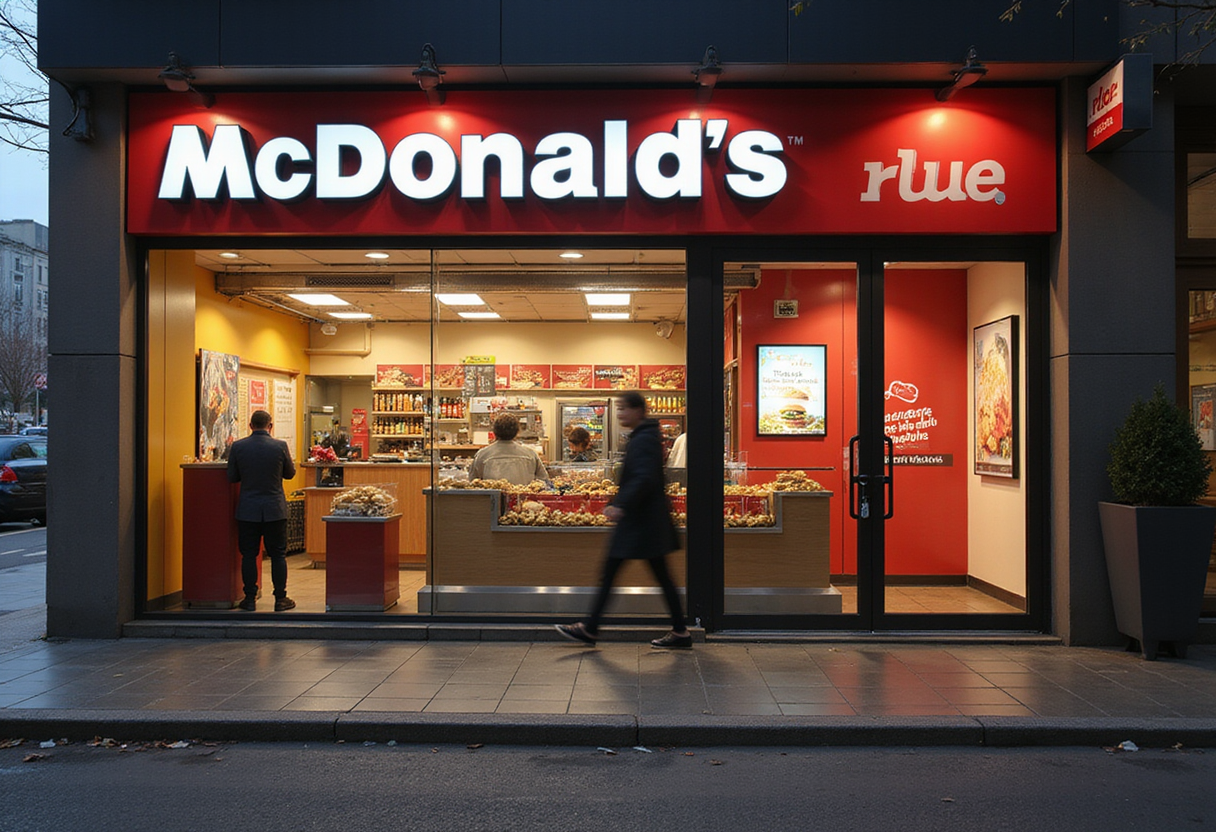
McDonald's Puts AI to Work at the Drive-Thru, Inventory and Order Accuracy
McDonald's is applying AI to its drive-thru, inventory management and order accuracy — a push aimed squarely at labor cost, waste and throughput in its highest-volume channel.
McDonald's is deploying artificial intelligence across three of its most cost-sensitive operational fronts: the drive-thru, inventory management and order accuracy. Restaurant Dive reports the move, which lands squarely in the chain's highest-volume channel — the drive-thru — where seconds of speed and pennies of waste translate into real margin.
That framing matters for operators. AI at the drive-thru doesn't sell more burgers. It compresses service time, cuts order-remake costs and reduces the labor hours tied to order-taking — the kind of unit-level economics that decide whether a franchisee clears its numbers.
What does the tech actually replace?
At the window or speaker box, AI order-taking systems replace — or augment — a crew member juggling the headset, the register and the lane. That's a labor-percentage play. For a business built on speed, every misheard order is a comped remake, a slowed lane and a drag on throughput at peak.
On inventory, AI tools promise tighter forecasting: ordering that tracks demand patterns rather than manager guesswork. For a system of McDonald's scale, even small percentage-point improvements in food cost and waste per restaurant compound quickly across thousands of doors.
Order accuracy is the third leg. Fewer errors mean fewer refunds, fewer remakes and fewer minutes lost during rush periods — all of which show up directly in cost of goods and labor lines.
Why now?
Fast food has spent the past several years under pressure from both directions: wage inflation on the labor side and commodity volatility on the cost-of-goods side. Automation that touches order capture, forecasting and error reduction attacks both at once, without requiring a menu price increase to pay for it.
The giants also have an advantage smaller independents don't: volume. A technology investment that pencils out across a massive system can be amortized in a way a single-unit operator can't match.
What does this change for operators?
For McDonald's franchisees, the question is who pays for the rollout and how quickly it hits their P&Ls — details that will shape adoption far more than the technology itself. For competitors, it raises the bar: if AI-driven speed and accuracy become the default at the biggest drive-thru operator in the business, matching that throughput becomes table stakes.
And for vendors in the restaurant-tech space, a McDonald's deployment at scale is the strongest possible validation — expect the ordering, forecasting and voice-AI categories to get more crowded, and more aggressively priced, as a result.
McDonald's hasn't laid out a firm timeline or unit count for the expansion in the report, so the near-term watch item is simple: how fast the tools move from pilot framing to system-wide standard, and what the franchisee economics look like when they do.
More from Daniel Okafor
Show full bio
Correspondent covering companies, deals and strategy in Restaurant and hotel operations at The Pass Brief.
330 articles